Blogs

Essential Textbooks (Theory & Design)

Coming soon

Coming soon

Primary flight instruments provide essential information about an aircraft’s motion, orientation, altitude, speed, and climb/descent. They are fundamental to flight mechanics, pilot decision-making, and aircraft control.

You can edit text on your website by double clicking on a text box on your websi...

Coming soon

Coming soon

Aircraft configurations

 The primary components of an aircraft include the fuselage (body), wings (which produce lift), tail assembly (responsible for stability), powerplant (engine, which generates thrust), and landing gear (for ground support), all managed from the cockpit through flight control surfaces such as ail...

Classification of Aircraft

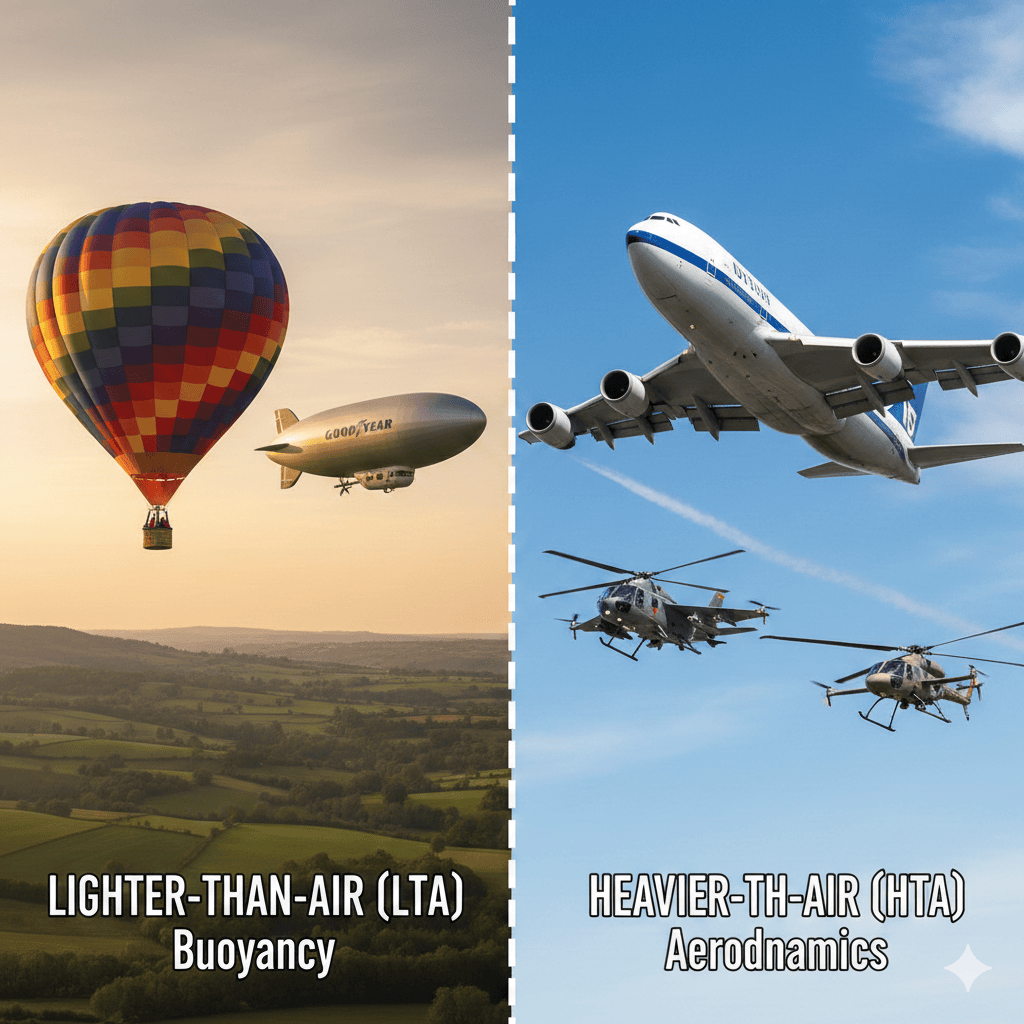
Lighter-than-air (Aerostats)

Lighter-than-air systems are the flight systems deriving a significant amount of their lift from the buoyancy effects related to lighter than air gases like hydrogen, helium and methane. Contrary to fixed-wing aircrafts LTA systems are associated with minuscule fuel consu...

  • Incompressible flow assumption

  • Applications: Lift, drag, flow visualization, UAVs, automobiles, buildings

  • Compressibility effects begin

  • Applications: Aircraft wings, airfoils, control surfaces

  • Before using the calculator, ensure availability of the following parameters:

    1. Temperature, T (Kelvin, K)

    2. Pressure, p (Pascal, Pa)

    3. Velocity, V (meters per second, m/s)

    4. Gas Constant, R (J/kg·K)

    5. Ratio of Specific Heats, γ

      After calculation, the following outputs will be displayed:

      1. Density (ρ...


  • Geometric Angle of Attack (α): The angle between the chord line and the common reference line (often the horizontal axis of the aircraft).
  • Induced Angle of Attack (α_i): The angle by which the local airflow is deflected (downwash) compared to the free-stream velocity.

  • Abs...


  • Developed by Dr. Aishwarya Dhara

    Machine Learning is a branch of Artificial Intelligence that enables computers to learn patterns from data and make predictions or decisions without being explicitly programmed.

  • Configuration: Quadrotor VTOL

  • Payload mass WplW = 1.2 kg

  • Hover time tht = 25 min = 0.417 hr

  • Design safety margin

  • Sea-level operation

  • Battery type: Li-Po

  • Hover T/W = 2.0 (safe VTOL design)