
Module 2
2.1 Classification of Aircraft
2.1 Classification of Aircraft
- AIRCRAFT
- LIGHTER-THAN-AIR
- Airships
- Free balloons
- Captive balloons
- HEAVIER-THAN-AIR
- MAN-POWER-DRIVEN
- NON-POWER-DRIVEN
- Gliders
- Sailplanes
- Kites
- POWER-DRIVEN
- AEROPLANE
- Land plane
- Seaplane
- Seaplane
- Amphibian
- ROTORCRAFT
- Helicopter
- Gyroplane
- Cyclogyro
- ORNITHOPTER
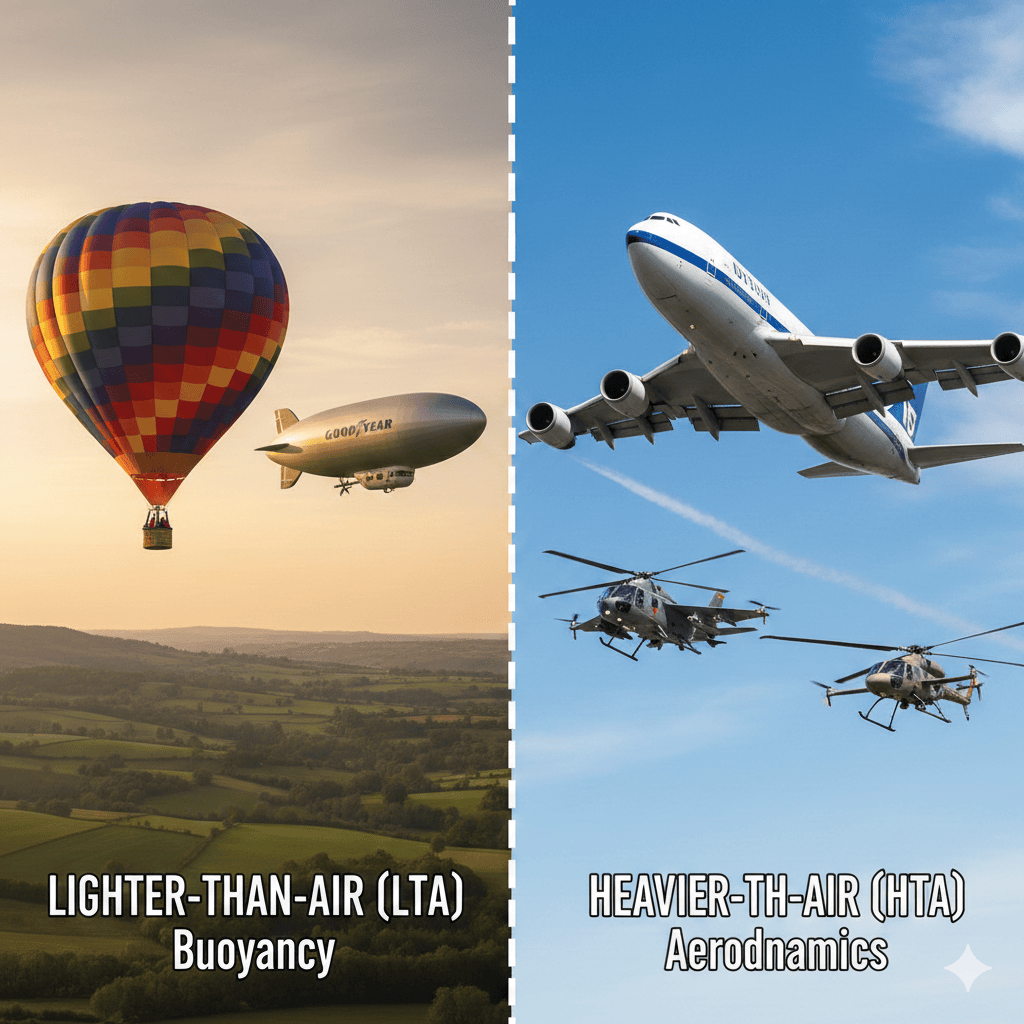
Lighter-than-air (Aerostats)
Lighter-than-air systems are the flight systems deriving a significant amount of their lift from the buoyancy effects related to lighter than air gases like hydrogen, helium and methane. Contrary to fixed-wing aircrafts LTA systems are associated with minuscule fuel consumption with their mobility expanding across extremely harsh terrains. LTA systems are further segregated into three different categories, viz. hot air balloons, aerostats and airships.
Balloons: Unpowered and move wherever the wind blows.
Airships (Dirigibles/Blimps): Powered by engines and have rudders for steering.
Lifting Gases: Modern airships use Helium because it is safe (non-flammable), unlike the Hydrogen used in the early 20th century.
Heavier-than-air
Heavier-than-air vehicles generally achieve flight with aerodynamic lift created by airflow over a surface (usually a wing). There were three basic types of early heavier-than-air vehicles: kites, gliders, and airplanes. Kites are unpowered, tethered craft. Gliders fly freely. Both kites and gliders are limited in their capabilities because they rely on the airflow provided by wind to remain aloft. Airplanes are powered aircraft that use their own propulsion to create airflow over their wings.
Classification of Heavier-Than-Air Aircraft (Aerodynes)
1. Man-Power & Non-Power-Driven
These aircraft rely on natural forces or human physical effort rather than engines.
- Man-Power-Driven: Aircraft propelled solely by the pilot's muscles (usually via pedals and a propeller).
- Gliders: Fixed-wing aircraft that are launched into the air and gradually descend, lacking an engine to maintain altitude.
- Sailplanes: High-performance gliders designed to "soar" by utilizing rising air currents to stay aloft for long periods.
- Kites: Aircraft tethered to a fixed point, deriving lift from the wind blowing against their surface.
These aircraft rely on natural forces or human physical effort rather than engines.
- Man-Power-Driven: Aircraft propelled solely by the pilot's muscles (usually via pedals and a propeller).
- Gliders: Fixed-wing aircraft that are launched into the air and gradually descend, lacking an engine to maintain altitude.
- Sailplanes: High-performance gliders designed to "soar" by utilizing rising air currents to stay aloft for long periods.
- Kites: Aircraft tethered to a fixed point, deriving lift from the wind blowing against their surface.
2. Power-Driven (Aeroplanes)
Fixed-wing aircraft that use engines (internal combustion or jet) to generate forward thrust.
- Land Plane: Designed to operate exclusively from solid ground using a wheeled undercarriage.
- Seaplane: Designed to take off and land on water.
- Floatplane: Uses separate pontoons (floats) attached to the fuselage.
- Flying Boat: The main fuselage/body acts as the hull and sits in the water.
- Amphibian: Equipped with both a water-capable hull/floats and retractable wheels for land operations.
Fixed-wing aircraft that use engines (internal combustion or jet) to generate forward thrust.
- Land Plane: Designed to operate exclusively from solid ground using a wheeled undercarriage.
- Seaplane: Designed to take off and land on water.
- Floatplane: Uses separate pontoons (floats) attached to the fuselage.
- Flying Boat: The main fuselage/body acts as the hull and sits in the water.
- Amphibian: Equipped with both a water-capable hull/floats and retractable wheels for land operations.
3. Rotorcraft
Aircraft that use rotating blades to provide lift and, in some cases, thrust.
- Helicopter: The engine drives the rotor blades to provide both vertical lift and horizontal movement.
- Gyroplane (Autogyro): The engine powers a propeller for thrust, while the overhead rotor spins freely (autorotation) to provide lift.
- Cyclogyro: Uses horizontal "paddle-wheel" rotors that can change the direction of thrust rapidly in any direction.
Aircraft that use rotating blades to provide lift and, in some cases, thrust.
- Helicopter: The engine drives the rotor blades to provide both vertical lift and horizontal movement.
- Gyroplane (Autogyro): The engine powers a propeller for thrust, while the overhead rotor spins freely (autorotation) to provide lift.
- Cyclogyro: Uses horizontal "paddle-wheel" rotors that can change the direction of thrust rapidly in any direction.
4. Ornithopter
An experimental or specialized aircraft that achieves flight by flapping its wings, mimicking the biological mechanics of birds, insects, or bats.
An experimental or specialized aircraft that achieves flight by flapping its wings, mimicking the biological mechanics of birds, insects, or bats.