Aircraft configurations

Module 3

3.1 History of Aviation
3.2 Aircraft parts
3.3 Aircraft Movements
3.1 History of Aviation
History of Aviation Timeline

Daedalus and Icarus

Ancient Greek Myth

A mythological story that symbolizes humanity's ancient and enduring desire to fly.

Tower jump

875

Abbas Ibn Firnas (Malaga, Spain) jumps from a high place with wooden wings covered in silk and feathers.

Leonardo da Vinci's Ornithopters

15th Century

Designed detailed human-powered flapping wing machines (ornithopters). While imaginative, this approach was not practical for flight.

Montgolfier Brothers' Hot-Air Balloon

Nov 21, 1783

The first sustained, manned flight in history. Carried humans over Paris, proving it was possible to leave the ground.

Sir George Cayley's Design

1799

A pivotal moment. Engraved the core concept of the modern airplane (fixed wing, separate tail, distinct systems for lift and thrust) on a silver disk. He is considered the "true inventor of the airplane" concept.

Otto Lilienthal's Gliders

1891–1896

Made the first successful, controlled flights in a fixed-wing glider. His over 2,000 flights provided crucial data and inspiration, proving wings could work.

1.6 WWII U.S. Navy Assault Drone

World War II

Early assault and expendable drones were fielded in limited roles during WWII.

The Wright Brothers' First Flight

Dec 17, 1903

The landmark achievement. At Kitty Hawk, NC, Orville and Wilbur Wright achieved the first controlled, sustained, powered, heavier-than-air, manned flight in history.

Louis Bleriot cross the Channel

1909

First person to cross the Channel with his monoplane Blériot XI in a 37-minute flight. DELAG company was founded, the first airline in mail and passenger transport.

Junkers F-13

1919

Early civil monoplane design that pioneered the use of aluminum in airframe construction.

Amelia Earhart

1932

She completes a nonstop transatlantic flight, thus becoming the first woman to accomplish this feat.

First jet fighter aircraft

1944

The Messerschmitt, first jet fighter aircraft, enters service with the German Luftwaffe.

Convention on International Civil Aviation

1947

Established rules of airspace, aircraft registration and safety, security, and sustainability, and details the rights of the signatories in relation to air travel.

Boeing composite flight

2009

Boeing performs its first B787 flight and becomes the first plane made from composite materials.

First hybrid aircraft

2014

Boeing tests the first hybrid aircraft capable of in-flight battery recharging.

Use left/right buttons or arrow keys to navigate the timeline.
3.2 Aircraft parts

Full Interactive Aircraft Anatomy

Hover over any component to see its aerodynamic role.

Select a Part

Hover over the aircraft diagram to explore the primary and secondary components.

 The primary components of an aircraft include the fuselage (body), wings (which produce lift), tail assembly (responsible for stability), powerplant (engine, which generates thrust), and landing gear (for ground support), all managed from the cockpit through flight control surfaces such as ailerons, flaps, and rudder. These essential parts function in unison to enable flight: the fuselage carries passengers and crew, wings generate lift, the tail ensures directional control, engines supply propulsion, and the landing gear facilitates movement on the ground. 

Aircraft Parts & Function
Wing
A wing is a structure which produces both lift and drag while moving through air. Wings are defined by two shape characteristics, an airfoil section and a planform. Wing efficiency is expressed as lift-to-drag ratio, which compares the benefit of lift with the air resistance of a given wing shape, as it flies. Aerodynamics includes the study of wing performance in air.
Fuselage
The fuselage is an aircraft's main body section. It holds crew, passengers, or cargo. In single-engine aircraft, it will usually contain an engine as well, although in some amphibious aircraft the single engine is mounted on a pylon attached to the fuselage, which in turn is used as a floating hull. The fuselage also serves to position the control and stabilization surfaces in specific relationships to lifting surfaces, which is required for aircraft stability and maneuverability.
Cockpit
The cockpit of the plane is where the plane is controlled. The cockpit is the section where the pilot and the co-pilot manage the aircraft. The two main functions of the cockpit are; to provide the pilot with a good angle and to make all control mechanisms accessible to them. Planes are also designed based on the same principle of any vehicle.
Vertical stabilizer
A vertical stabilizer or tail fin is the static part of the vertical tail of an aircraft. The term is commonly applied to the assembly of both this fixed surface and one or more movable rudders hinged to it. The vertical tail of an aircraft typically consists of a fixed vertical stabilizer or fin on which a movable rudder is mounted. A trim tab may similarly be mounted on the rudder. Together, their role is to enable trim in the yaw direction (compensate moments in yaw generated by any asymmetry in thrust or drag), enable the aircraft to be controlled in yaw (for example, to initiate side slip during a crosswind landing), as well as provide stability in yaw (weathercock or directional stability).
Horizontal stabilizer
A horizontal stabilizer is used to maintain the aircraft in longitudinal balance, or trim: it exerts a vertical force at a distance so the summation of pitch moments about the center of gravity is zero. The vertical force exerted by the stabilizer varies with flight conditions, in particular according to the aircraft lift coefficient and wing flaps deflection which both affect the position of the center of pressure, and with the position of the aircraft center of gravity (which changes with aircraft loading and fuel consumption).
Flaps & Slats
During takeoff and landing the airplane's velocity is relatively low. To keep the lift high (to avoid objects on the ground!), airplane designers try to increase the wing area and change the airfoil shape by putting some moving parts on the wings' leading and trailing edges. The part on the leading edge is called a slat, while the part on the trailing edge is called a flap. The flaps and slats move along metal tracks built into the wings. Moving the flaps aft (toward the tail) and the slats forward increases the wing area. Pivoting the leading edge of the slat and the trailing edge of the flap downward increases the effective camber of the airfoil, which increases the lift. In addition, the large aft-projected area of the flap increases the drag of the aircraft. This helps the airplane slow down for landing.
Engine
An aircraft engine, often referred to as an aero engine, is the power component of an aircraft propulsion system. Aircraft using power components are referred to as powered flight. Most aircraft engines are either piston engines or gas turbines, although a few have been rocket powered and in recent years many small UAVs have used electric motors.
3.3 Aircraft Movements

Basic Aircraft movement

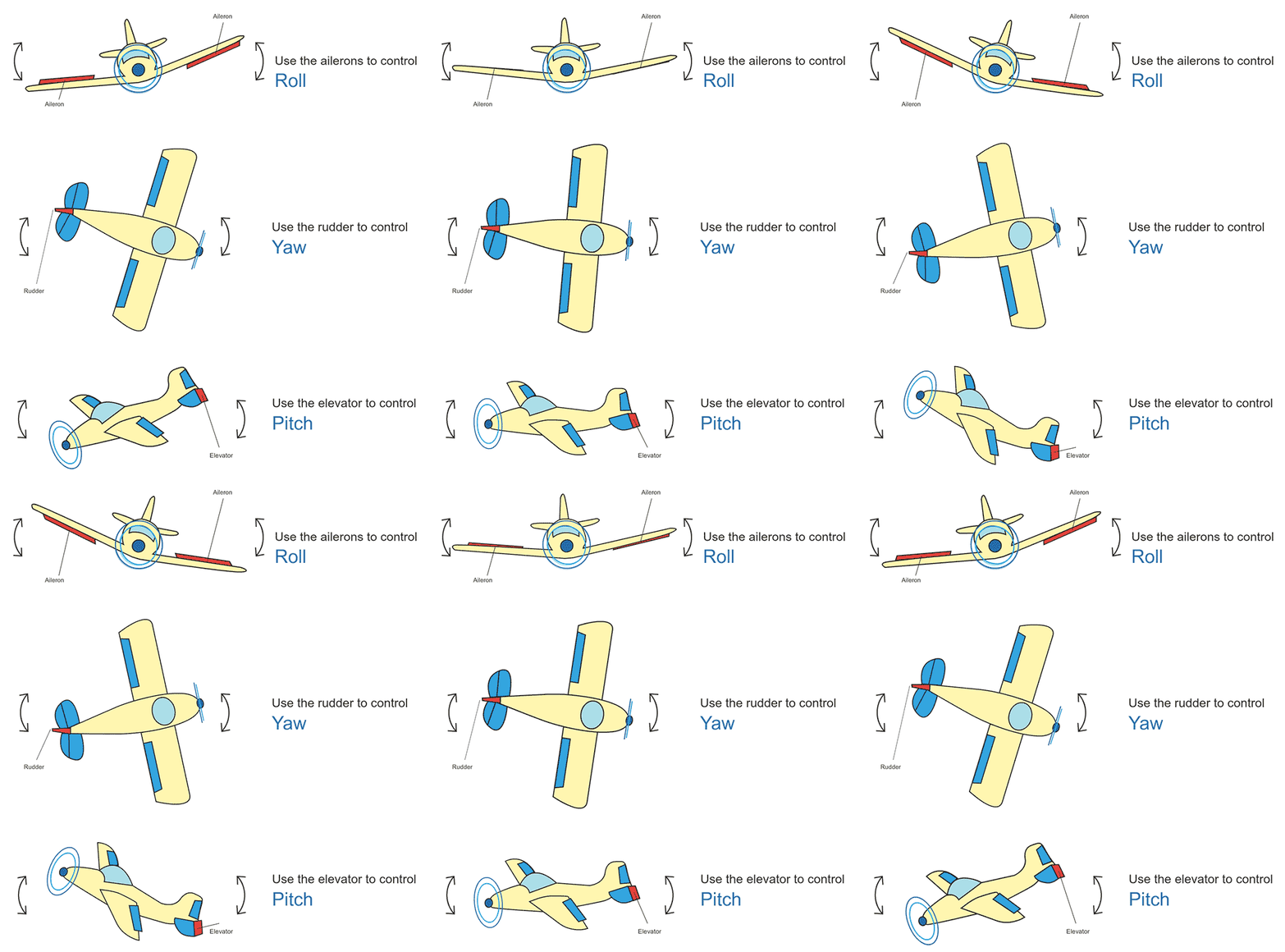
  • Flight controls allow a pilot to manage an aircraft's orientation and flight path by manipulating the airflow over specific surfaces. These are categorized into Primary and Secondary controls. All flight maneuvers are a combination of three fundamental movements: Pitch, Roll, and Yaw.
  • Rotation around the front-to-back axis is called roll
  • Rotation around the side-to-side axis is called pitch.
  • Rotation around the vertical axis is called yaw.

Aircraft Front View Anatomy

Hover over the parts to see the primary control surfaces.

Hover a part

Details will appear here.

Aircraft Flight Dynamics Dashboard

Primary Flight Controls

Interaction Simulation

Pitching (Elevator)

Elevator Down (CW)Elevator Up (ACW)
Level flight.

Rolling (Ailerons)

Roll LeftRoll Right
Wings level.

Yawing (Rudder)

Yaw LeftYaw Right
Steady heading.

A. Ailerons (Roll)

  • Location: Trailing edge of the outboard wings.

  • Axis: Longitudinal axis (nose to tail).

  • Action: They move in opposite directions. When the stick is moved left, the left aileron goes UP (decreasing lift) and the right aileron goes DOWN (increasing lift), causing the aircraft to roll left.

B. Elevator (Pitch)

  • Location: Trailing edge of the horizontal stabilizer (the tail).

  • Axis: Lateral axis (wingtip to wingtip).

  • Action: When the pilot pulls back on the stick, the elevator moves UP. This creates a downward force on the tail, pivoting the aircraft nose upward.

C. Rudder (Yaw)

  • Location: Trailing edge of the vertical stabilizer (the fin).

  • Axis: Vertical axis (up through the center of the fuselage).

  • Action: Controlled by foot pedals. Pushing the left pedal deflects the rudder LEFT, pushing the tail right and yawing the nose to the left.
Back
Share -