
Module 4
| Mach Number (M) | Flow Regime |
|---|---|
| M < 0.3 | Incompressible |
| 0.3 ≤ M < 0.8 | Subsonic |
| 0.8 ≤ M < 1.2 | Transonic |
| 1.2 ≤ M ≤ 5 | Supersonic |
| M > 5 | Hypersonic |
1. Equation of State
p = ρRT
2. Specific Heats
cp − cv = R
γ = cp / cv
Typical values for air:
cp ≈ 1005 J/kg·K
cv ≈ 718 J/kg·K
γ ≈ 1.4
3. Internal Energy
u = cvT
du = cvdT
4. Enthalpy
h = u + pv = cpT
dh = cpdT
5. Speed of Sound
a = √(γRT)
6. Isentropic Relations
T2/T1 = (p2/p1)(γ−1)/γ
ρ2/ρ1 = (p2/p1)1/γ
T2/T1 = (ρ2/ρ1)γ−1
7. Entropy Change
ds = cp ln(T2/T1) − R ln(p2/p1)
ds = cv ln(T2/T1) + R ln(v2/v1)
- Gas molecules have negligible volume
- No intermolecular forces exist between gas molecules
- Specific heats cp, cv, and ratio of specific heats γ are constant
- Model is valid at moderate temperatures and pressures
SOPs to use calculator
Before using the calculator, ensure availability of the following parameters:
Temperature, T (Kelvin, K)
Pressure, p (Pascal, Pa)
Velocity, V (meters per second, m/s)
Gas Constant, R (J/kg·K)
Ratio of Specific Heats, γ
After calculation, the following outputs will be displayed:
Density (ρ)
Speed of Sound (a)
Mach Number (M)
Thermodynamic Calculator
(Perfect Gas)
Concept of Shock Wave
A shock wave is a very thin region in a compressible flow where fluid properties change abruptly and irreversibly due to supersonic motion.
Key Characteristics
Occurs only when Mach number (M > 1)
Extremely thin (order of mean free path)
Causes entropy increase
Converts kinetic energy into thermal energy
Property Changes Across a Shock
Pressure ↑; Temperature ↑ ; Density ↑
Velocity ↓; Mach number ↓
Concept of Normal Shock Wave
A normal shock is a shock wave perpendicular to the direction of flow.
Where It Occurs
Inside convergent–divergent nozzles
In supersonic inlets
Ahead of blunt bodies at certain conditions
Flow Behavior
Supersonic flow becomes subsonic
Large pressure and temperature rise
Key Relations
Upstream Mach: >
Downstream Mach:
Energy Loss
High total pressure loss and Strong shock
Concept of Oblique Shock Wave
An oblique shock is a shock wave inclined at an angle to the flow direction.
Where It Occurs
Over wedges
At compression corners
Supersonic aircraft wings and inlets
Flow Behavior
Flow is turned toward itself
Mach number decreases but may remain supersonic
Weaker than normal shock
Key Angles
Shock angle (β) and Flow deflection angle (θ)
Special Case
When deflection angle increases → oblique shock becomes normal shock
Concept of Expansion Shock Wave
Nature
Isentropic process
Occurs as a fan of infinite weak waves
Reversible (no entropy increase)
Property Changes
Pressure ↓
Temperature ↓
Density ↓
Velocity ↑
Mach number ↑
Where It Occurs
Nozzle expansion
Trailing edges of wings
External expansion corners
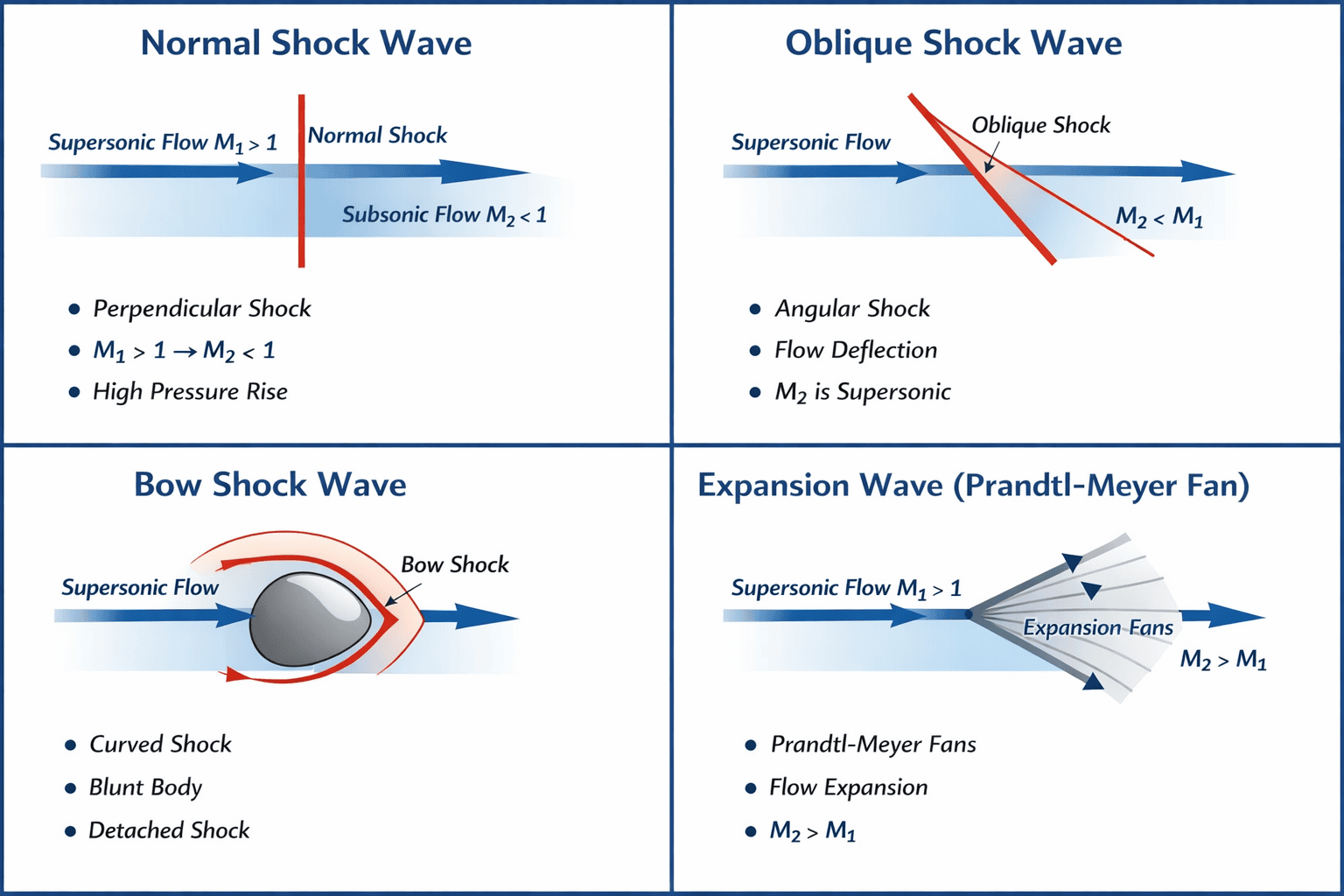
Compressible Flow Concepts
Flow through ducts
Numerical Problems
Developed by Dr. Aishwarya Dhara