
Module 6
Takeoff occurs when: Lift ≥ Weight and sufficient thrust overcomes drag and rolling resistance.
Rate of climb (RoC) is the vertical speed of an aircraft, commonly measured in feet per minute (fpm), representing the rate of altitude gain. It is driven by excess power—the difference between power available and power required—and is heavily influenced by weight, density altitude, and aerodynamic drag.
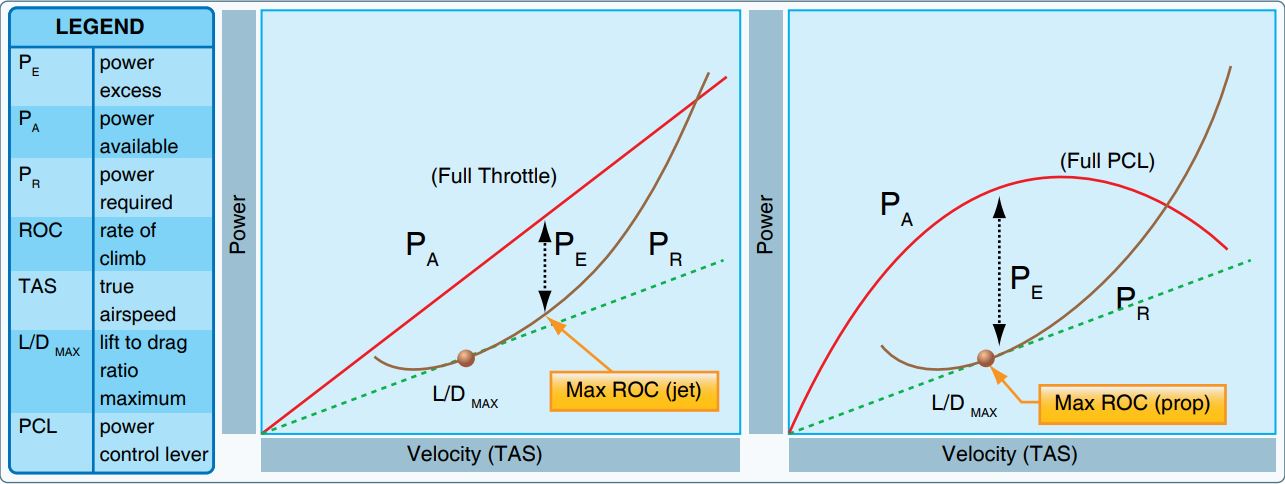
Best Rate of Climb comparison for jet and propeller aircraft. Source: FAA Pilot Handbook
Altitude: Rate of climb decreases as altitude increases due to lower air density reducing engine thrust.
Weight: Higher gross weight decreases rate of climb and requires a lower.
Temperature: Higher temperatures decrease air density, reducing engine power and propeller efficiency, resulting in a lower RoC.
Aerodynamics: Lower drag (clean configuration) increases RoC.
Angle of Climb (AOC) is the angle between the aircraft’s flight path and the horizontal ground.
It represents how much altitude is gained compared to horizontal distance traveled.
Angle of Climb measures steepness of ascent, and maximum AOC is achieved when the aircraft has maximum excess thrust, allowing it to clear obstacles efficiently.
To achieve Maximum Angle of Climb (VX), by flying at VX (best angle-of-climb speed) and provides maximum altitude gain in the shortest horizontal distance.
AOC depends on excess thrust available.
Excess thrust = Thrust available − Thrust required.
The greater the excess thrust, the steeper the climb angle.
Jet aircraft:Maximum AOC occurs near the speed where thrust required is minimum (around L/D max).
Propeller aircraft:Maximum AOC usually occurs below L/D max speed, often just above stall speed.
Coming soon
Coming soon