
Blog tagged as aerodynamics
- Aircraft Performance and Design by John D. Anderson, Jr. (McGraw-Hill): Often considered the standard text for understanding flight mechanics and performance, covering both jet and propeller-driven aircraft.
- Flight Performance of Aircraft (AIAA ...
Primary flight instruments provide essential information about an aircraft’s motion, orientation, altitude, speed, and climb/descent. They are fundamental to flight mechanics, pilot decision-making, and aircraft control.
You can edit text on your website by double clicking on a text box on your websi...
The primary components of an aircraft include the fuselage (body), wings (which produce lift), tail assembly (responsible for stability), powerplant (engine, which generates thrust), and landing gear (for ground support), all managed from the cockpit through flight control surfaces such as ail...
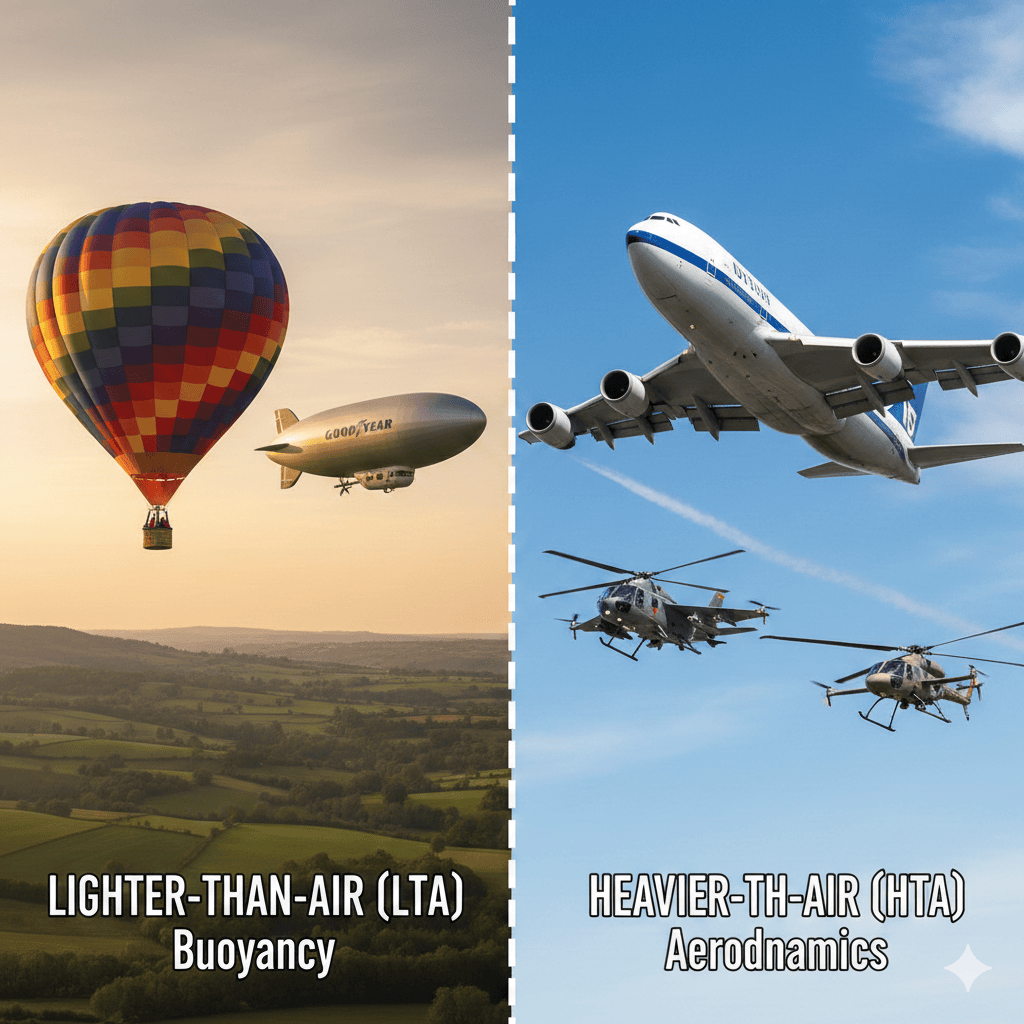
Lighter-than-air (Aerostats)
Incompressible flow assumption
Applications: Lift, drag, flow visualization, UAVs, automobiles, buildings
Compressibility effects begin
Applications: Aircraft wings, airfoils, control surfaces
Induced Angle of Attack (α_i): The angle by which the local airflow is deflected (downwash) compared to the free-stream velocity.
Abs...
Before using the calculator, ensure availability of the following parameters:
Temperature, T (Kelvin, K)
Pressure, p (Pascal, Pa)
Velocity, V (meters per second, m/s)
Gas Constant, R (J/kg·K)
Ratio of Specific Heats, γ
After calculation, the following outputs will be displayed:
Density (ρ...
As I went on, still gaining velocity, the palpitation of night and day merged into one continuous greyness; the sky took on a wonderful deepness of blue, a splendid luminous color like that of early ...
Understanding the atmosphere is essential for safe and efficient flight, as atmospheric properties directly influence aircraft performance, control, aerodynamic behavior, and the accuracy of flight instruments.


