
Module 3
Frame
Propellers
Motors
Battery
Flight control cards
Power distribution board
Electronic speed controller
Drone controller and receiver
Payload and Sensors
| Drone Type | Motors | Stability | Payload Capacity | Best Use Case |
|---|---|---|---|---|
| Monocopter | 1 | Limited | Very Low | Basic vertical flight |
| Bicopter | 2 | Basic | Low | Simple applications |
| Tricopter | 3 | Good | Medium | Hobby flying, light photography |
| Quadcopter | 4 | Excellent | Medium-High | Most applications, consumer drones |
| Hexacopter | 6 | Very High | High | Professional photography, redundancy |
| Octocopter | 8 | Exceptional | Very High | Heavy payloads, professional filming |
Power Systems provides energy to motors, avionics, and payload.
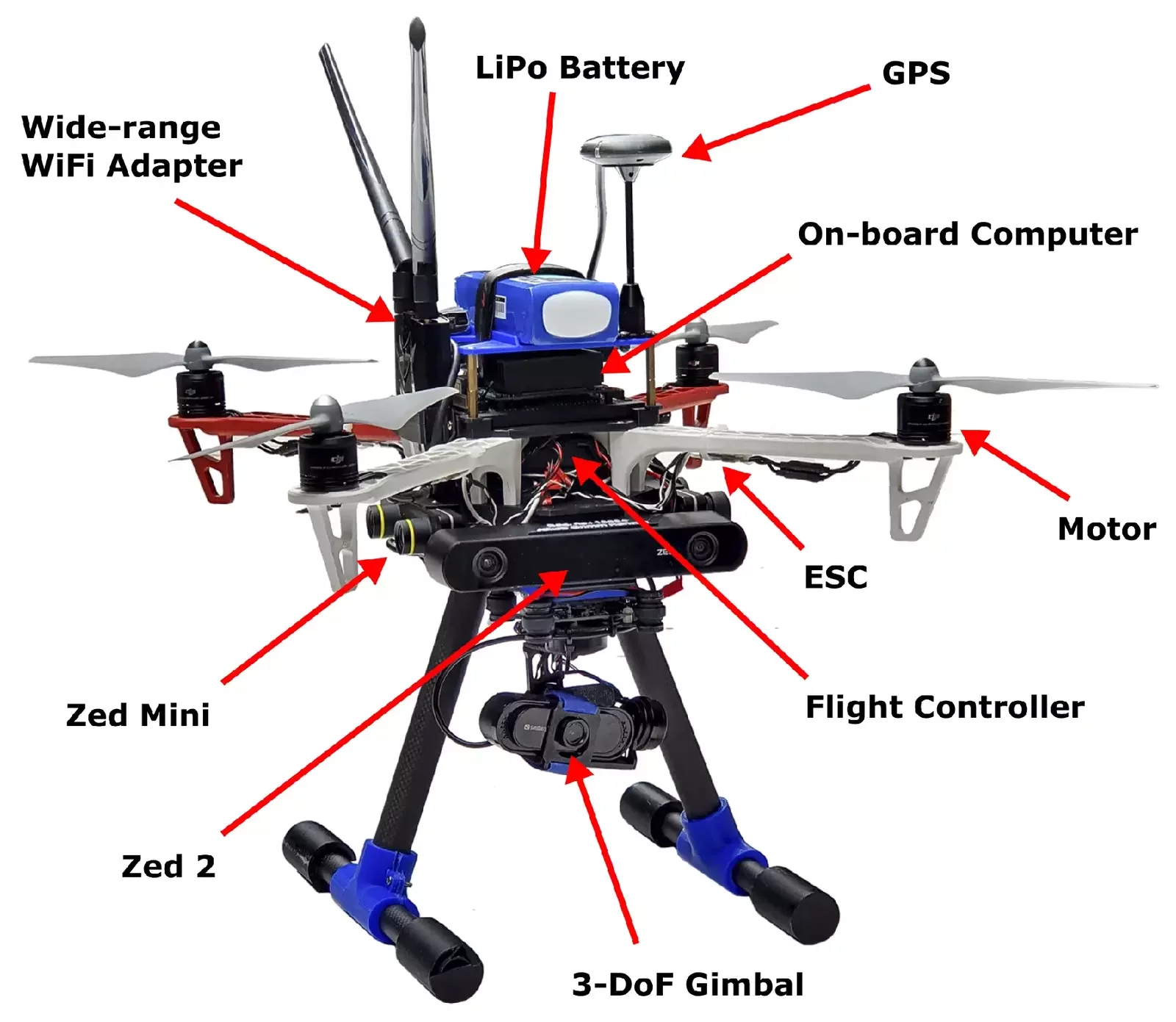
PDB (Power Distribution Board),is the circuit board organizes the power connections of batteries, ESCs, and other onboard systems. In particular, it is responsible for power distribution from the flight battery to each electronic speed controller for the drone control board.
In some cases, the PDB is also used to power components such as the camera, LED taillights, and flight controller.
The battery, described as the heart of the drone, is the most important part in terms of power generation and performance.
Fligh control Systems is the brain of the UAV which provides stabilizes and controls motion.
It containtsContains:Flight Controller (FC),IMU sensors: Accelerometer, Gyroscope, Magnetometer,GPS module, Barometer (altitude measurement), and Telemetry module (communication with ground station).
Communication Systems ensures data exchange between UAV and ground control.
It performs through:Radio Controller + Receiver (RC Link),Telemetry (915 MHz / 2.4 GHz / 5.8 GHz), and FPV system (camera + video transmitter).
| Category | Examples |
|---|---|
| Imaging Payloads | RGB camera, thermal camera, multispectral, hyperspectral, low-light camera, 360° camera |
| Remote Sensing Payloads | LiDAR, Synthetic Aperture Radar (SAR), Ground Penetrating Radar (GPR) |
| Environmental Sensors | Air quality sensors, meteorological sensors, radiation sensors, wildlife tracking sensors |
| Agricultural Payloads | Spraying tanks, seed-dropping system, plant health sensors |
| Industrial Inspection Sensors | Thermal imagers, zoom cameras, ultrasonic sensors, magnetic sensors |
| Delivery Payloads | Cargo boxes, insulated medical transport pods |
| Navigation Sensors | GPS/GNSS, IMU, magnetometer, barometer, optical flow sensor, ToF sensor |
| Obstacle Avoidance Sensors | Ultrasonic sensors, LiDAR rangefinder, stereo vision cameras |
| Communication & Mission Sensors | FPV camera, telemetry radio, ADS-B receiver, RF sensors |
| Category | Description | Typical Weight Share |
|---|---|---|
| Structural Weight (Wstr) | Airframe, wings, fuselage, landing gear; main load-bearing elements | 30–50% |
| Propulsion System (Wprop) | Motors/engines, propellers, ESCs, fuel system | 10–25% |
| Power System (Wpower) | Battery, fuel cells, power electronics | 20–40% |
| Avionics (Wav) | Flight controller, GPS, sensors, telemetry module | 5–15% |
| Payload (Wpayload) | Camera, LiDAR, sprayer, delivery package, mission sensors | 5–30% |
| Total Weight (Wₜ) | W = Wstr + Wprop + Wpower + Wav + Wpayload | 100% |
UAVs can carry various surveillance packages, including electro-optical and infrared cameras, SAR, SIGINT, and multi- and hyperspectral imagers for reconnaissance/surveillance missions.
There are basically three types of surveillance missions: 1. Convoy over-watch, 2. Route surveillance, and 3. Fixed surveillance.
Three primary functions of surveillance sensors are: 1. detection, 2. recognition, and 3. Identification.
Two most common kinds of surveillance payloads (i.e., sensors) are: 1. Daytime or night-vision camera, 2. Radar.
Some significant ones are spectrometers, radiation detectors, environmental sensors, and atmospheric sensors.
A spectrometer analyzes the spectrum of light to identify the chemical elements of the target. For instance, Mars Rover is equipped with a rock-zapping laser and telescope. It produces more than a million watts of power focused for five one-billionths of a second to hit targets up to seven meters away. The result is a glowing ionized gas which it observes with the telescope. The light, then, is analyzed by spectrometer.
A radiation detector monitors high-energy atomic and sub atomic particles coming from the sun, from distant supernovae and other sources to determine whether conditions are favorable to life and preserving evidence of life. Naturally occurring radiation is harmful to microbes and human life. The Earth atmosphere has a protective magnetic field against radiation.
An environmental sensor records environmental information such as carbon monoxide, water vapor, aerosols, ozone, gases composing air, air viscosity, chemicals in the air, and ultraviolet radiation. The wind speed and direction, temperatures, and humidity are measured by electronic devices. The atmospheric pressure is measured by a barometer. Some other atmospheric phenomena include rain, icing, snow, wind, gust, turbulence, hurricane, tornado, thunderstorm, and lightning.
An atmospheric sensor records atmospheric information such as wind speed, wind direction, air pressure, relative humidity, air temperature, ground temperature. The wind speed and direction, temperatures, and humidity are measured by electronic devices. The atmospheric pressure is measured by a barometer.
| Category | Sub-Category | Description / Key Points | Examples |
|---|---|---|---|
| Group 1: Lethal Missions | Strike / Attack | Delivery of lethal warhead to destroy target. | Precision attack, missile strike |
| Interception | Neutralizing or destroying hostile threats. | Air defense interception | |
| Destructive Operations | Operations using explosive mechanisms. | IED neutralization, landmine destruction | |
| Group 2: Non-Lethal Missions | Reconnaissance & Surveillance | Observation and intelligence gathering without weapons. | ISR missions |
| Electronic Intelligence (ELINT) | Collecting electronic signals for intel assessment. | Signal monitoring, radar mapping | |
| Target Designation | Laser-guiding targets for precision weapons. | Laser target marking | |
| Weapon Payload Category | Stores & Munitions | Physical weapons carried by UAVs. | Missiles, rockets, bombs |
| Under-Wing Mounting | Externally attached weapons released or launched. | UAV hardpoints | |
| Payload–Range Trade-Off | More weapons reduce range; fewer increase endurance. | Mission optimization | |
| Design Considerations for Armed UAVs (UCAVs) | Take-Off Capability | Must safely take off with full weapon load. | Reduced fuel for heavier payloads |
| Mechanical & Electrical Interfaces | Secure connections between UAV and weapons. | Pylons, release systems | |
| Launch Safety | Must ensure stability and safety during firing. | Separation safety | |
| Branch-Specific Payload Differences | Army missiles lighter than Air Force missiles. | Predator uses lighter Hellfire missiles | |
| Example Weapon Payload | AGM-114 Hellfire Missile | Air-to-surface precision missile for anti-armor/targets. | Used for high-value target strikes |
| Key Characteristics | 163 cm length, 45 kg, solid-fuel motor, laser-guided, 8 km range. | Predator carries up to 2 Hellfires |
| Category | Sub-Types / Classes | Key Characteristics | Typical UAV Use |
|---|---|---|---|
| Electro-Optic (EO) | Monochrome / Color Cameras, HDTV, Low-light cameras, Multi-spectral cameras | Operates in visible band (0.4–0.7 μm), high clarity, true-color images | General surveillance, inspection, mapping |
| Infrared (IR) | Near-IR, Mid-wave IR, Long-wave IR thermal cameras | Captures heat signatures, works in dark/obscured conditions, 0.7–1000 μm | Night operations, search & rescue, target detection |
| Laser-Based Sensors | Laser Designators, Range Finders, LIDAR | Provides range, designation marking, synthetic mapping | Target marking, terrain mapping |
| Camera Format Types | Rangefinder, SLR, TLR, Instant, Large/Medium Format, Subminiature, Digital, Camcorder, Panoramic, VR | Varies by optics, size, pixel count, and lens system | Specialized documentation, panoramic mapping, VR capture |
| Low-Cost UAV Cameras | FPV Cameras, GoPro-class EO modules | Light, low-power, 720p–1080p, Wi-Fi enabled, low price (~$60) | Hobby FPV, training, short-range surveillance |
| Advanced Rover/UAV Cameras | Multi-camera arrays, autofocus arms, high-resolution sensors | Up to 1600×1200 px, 13.9 μm resolution, f/8.5–f/9.8, 720p video, multimillion-dollar systems | Planetary missions, high-precision robotics |
| Gimbal-Mounted Systems | 2-axis, 3-axis gyro-stabilized EO/IR turrets | 360° azimuth view, stabilization, zoom, tracking | Reconnaissance, ISR missions (e.g., CONTROP, Stalker VXE30) |
| Selection Parameters | Dimensions, weight, resolution, FPS, FOV, zoom, power, software, storage, focus, IR sensitivity, etc. | Determines suitability for mission-profile and payload limits | Design & procurement evaluation |
2. Mark Pinney Aerodynamics of Missiles and Rockets. McGraw-Hill Education, 2013.
3. Marvin Hobbs Fundamentals of Rockets, Missiles, and Spacecraft. J.F. Rider, 1962.
4. Sethunathan, P., Sugendran, R. N., & Anbarasan, T. Aerodynamic Configuration design of a missile at Int J Eng Res & Technol (IJERT), 2015.
5. Jack N. Nielsen Missile Aerodynamics. NIELSEN ENGINEERING & RESEARCH, INC, 1988.
6. Siouris, George Missile Guidance and Control Systems. Springer New York, 2006.